

Brothers and Sisters:
There are two basic functions that all employers, whether there is one paid employee or 100,000 paid employees, must adhere to in order to have a reasonable chance of success. First is to collect money for the goods and services they sell and second is to pay their bills. The most important part of paying bills is to make payroll.
Making payroll for small operations can be very stressful at times for the owners. This is a truth since the first employee was hired on and is true today. When we hear on a regular basis that one or more of our major IUEC employers has trouble with their payroll system, it makes us all stand up and pay attention.
Each one of us runs our household in a very similar manner to a company. We sell our time to our employers, receive pay for that time which equates to income or sales. We then pay our household expenses and what is left is our profit. The same as any company.
Our households do not per se pay payroll. An argument can be made that paying a child an allowance is analogous to making payroll but, I will leave that to your own interpretation.
In my 25 years in the elevator trade, I have had one major payroll issue when I was shorted 17 hours in a check. A phone call to the office made a check appear for the balance of the hours that afternoon. The taxes were sorted out the following week.
I do have some questions and observations about what seems to be a never ending conversation between the signatories, local offices, union and the employees. These problems do not seem to be localized to one company, all share in some variation of the problem.
Is there a locus, or starting point which can be identified? Is the processing company getting the data from the employers in a form it can use? Are the employers properly inputing the data for the employees? Is the processing company aware of the different rates paid in the different jurisdictions? Do they have a way of calculating the proper benefit information based on hours worked? Are they supplied with that information? By whom? Is the processor aware of the difference between a represented and non-represented employee and the payroll implications of those differences? Are the supervisors authorizing time in a timely manner? Are the Locals informing the local offices of the changing status of apprentices as they work their way through the program and are the local offices making those changes?
When I know the name of the head of Labor Relations for my company and have access to his personal phone number, the fire has hit the Executive Suite. This is when good investigation and troubleshooting skills by everyone on both sides of the ledger are the most valuable tool the union and signatories hold.
At the end of the day, we as employees, whether represented or non-represented, have a symbiotic relationship with our employer: we sell them our time, which they bill our customers for and pay us as agreed to in either the Collective Bargaining Agreement or corporate employment agreement.
As I’ve told many of my apprentices, problems are like onions. Peel away each of the layers and eventually you find the core issue. Fix the core issue and the problem goes away.
The Brothers and Sisters of IUEC Local 17 send their condolences to the family of Honorary Retiree Jim Dacey.
As of this writing there is one mechanic on the bench.
Until next month,
work smart, work safe and slow down for safety.
Don

Sister Andrea Rodriguez (right) at the Women Building Nations Conference with her husband Ernie (left) and IUEC General President Frank Christensen.
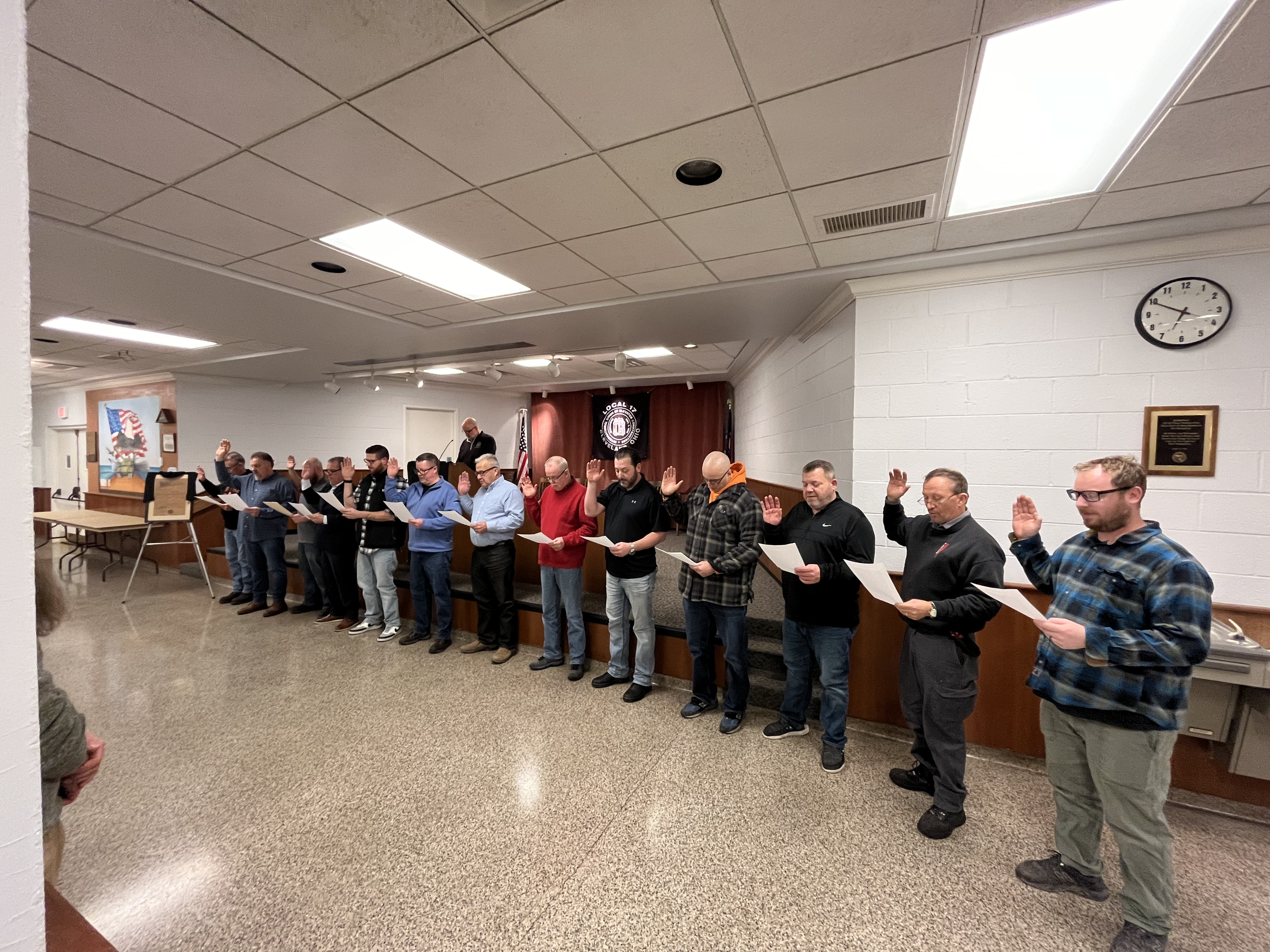
The January Special Called Meeting for the installation of officers. Brothers Mike Hogan (far left) and Jack Finucan (fourth from right) join as the new Conductor and Trustee.
 International Union of Elevator Constructors Local 17